Life contingencies
riskpy.life is the life-and-pensions half of actuarial science: a survival
model (a life table), an interest rate, and the present-value formulas that
turn the two into insurance and annuity prices, premiums and reserves.
It is pure Python — math only — so it works in the zero-dependency
install:
from riskpy import life

sult = life.LifeTable.sult()                         # the AMLCR standard table
life.whole_life_insurance(sult, 40, i=0.05)          # A_40  = 0.121059
life.whole_life_annuity_due(sult, 40, i=0.05)        # ä_40  = 18.457757
life.whole_life_premium(sult, 40, i=0.05)            # P_40  = 0.006559
Those three numbers are the ones printed in Dickson, Hardy & Waters, Actuarial Mathematics for Life Contingent Risks, Table D.3 — which is the point of shipping the Standard Ultimate Life Table: every worked answer in that book is a test case.
Conventions
- Ages and durations are integers. A table is a discrete survival model:
q_xis the probability a life aged exactlyxdies beforex + 1. iis the effective annual rate as a decimal —0.05, not5.- Insurances pay 1 at the end of the year of death (
A_x); annuities-due pay 1 at the start of each year while alive (ä_x). Passcontinuous=Truefor the uniform-distribution-of-deaths adjustmentĀ = (i/δ)·Aon insurances and Woolhouse'sā ≈ ä − ½on annuities. Both are approximations; each docstring says how good. - A table must close: its last
q_xis 1. Every identity below depends on it, so a table that does not close is rejected rather than truncated.
Life tables
table = life.LifeTable(qx=[0.001, 0.0012, ..., 1.0], start_age=20)
table = life.LifeTable.from_lx([100_000, 99_900, ...], start_age=20)
table = life.LifeTable.gompertz(B=2.7e-6, c=1.124)               # μ_x = B·c^x
table = life.LifeTable.makeham(A=0.00022, B=2.7e-6, c=1.124)     # μ_x = A + B·c^x
table = life.LifeTable.from_force(lambda x: 0.0002 + 2.7e-6 * 1.124 ** x)
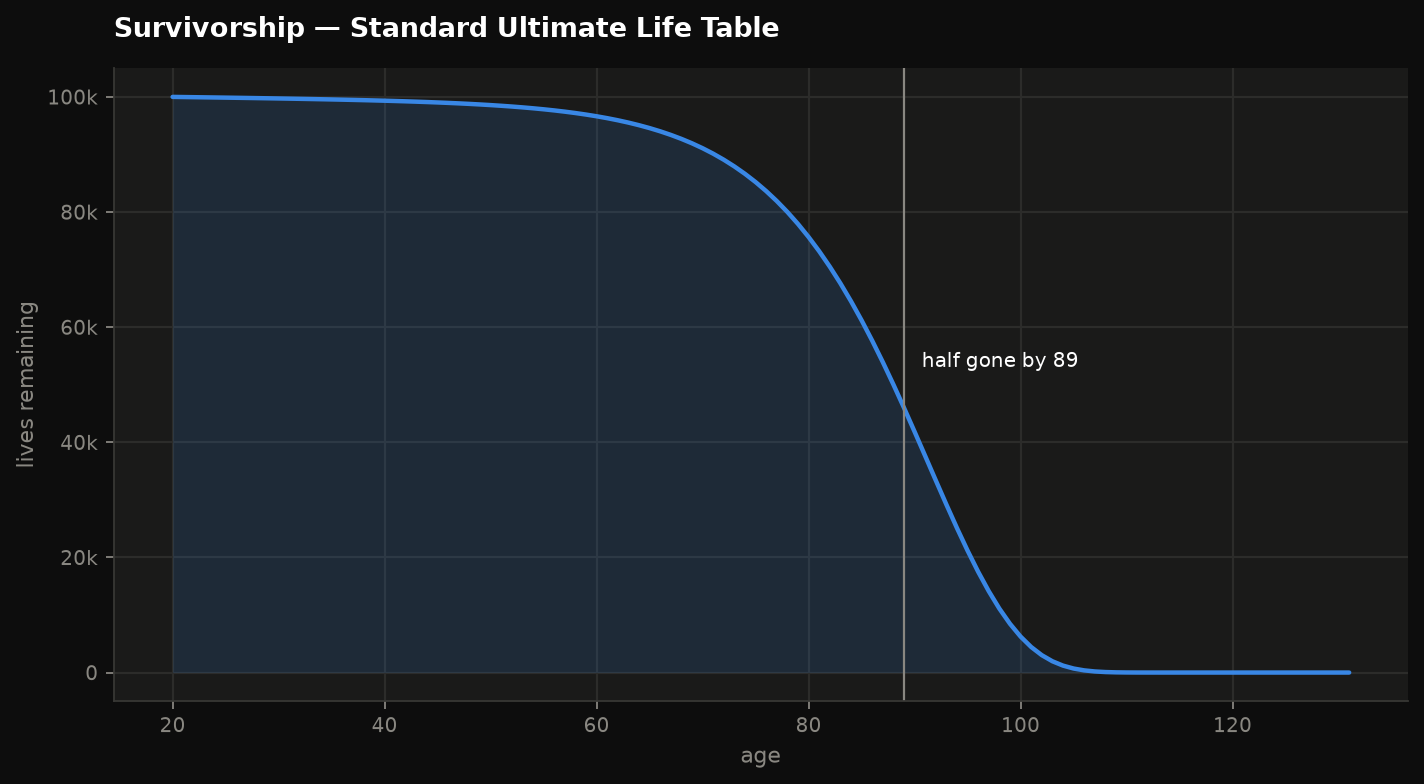
table = life.LifeTable.sult()                                    # Makeham, ages 20–130
makeham uses the closed form for t_p_x, so its rates are exact;
from_force integrates any force of mortality with Simpson's rule (error
around 1e-12 for Gompertz-like laws at the default 64 steps).
A steep law closes early
Gompertz with c = 1.15 reaches q_x = 1 in floating point in the
mid-nineties. The generated table closes there, with a RuntimeWarning
saying so, rather than carrying thirty ages of lives no one can reach.
table.qx(40), table.px(40), table.lx(40), table.dx(40)
table.tpx(10, 40)              # 10_p_40
table.deferred_qx(10, 40)      # 10|q_40 — dies in the year after age 50
table.curtate_expectation(40)  # e_40 = 45.78 on the SULT
table.survival_curve()         # (ages, l_x) — for viz.survival
table.mortality_curve()        # (ages, q_x) — for viz.mortality
Interest
life.discount_factor(0.05)        # v = 0.952381
life.discount_rate(0.05)          # d = 0.047619
life.force_of_interest(0.05)      # δ = 0.048790
life.nominal_rate(0.05, m=12)     # i^(12)
life.annuity_certain(0.05, 10)    # 7.721735;  due=True → 8.107822
Insurances and annuities
Every function takes (table, x, i, …) and returns the actuarial present
value per unit of benefit.
| Insurance | Annuity | ||
|---|---|---|---|
whole_life_insurance(t, x, i) |
A_x |
whole_life_annuity_due(t, x, i) |
ä_x |
term_insurance(t, x, n, i) |
A¹_{x:n} |
whole_life_annuity_immediate(t, x, i) |
a_x |
pure_endowment(t, x, n, i) |
ₙE_x |
temporary_annuity_due(t, x, n, i) |
ä_{x:n} |
endowment_insurance(t, x, n, i) |
A_{x:n} |
temporary_annuity_immediate(t, x, n, i) |
a_{x:n} |
deferred_whole_life_insurance(t, x, m, i) |
ₘ|A_x |
deferred_annuity_due(t, x, m, i) |
ₘ|ä_x |
increasing_insurance(t, x, i) |
(IA)_x |
increasing_annuity_due(t, x, i) |
(Iä)_x |
mthly_annuity_due(t, x, i, m) |
ä_x^{(m)} (Woolhouse) |
life.term_insurance(sult, 40, 20, 0.05)       # 0.014633
life.pure_endowment(sult, 40, 20, 0.05)       # 0.366630
life.endowment_insurance(sult, 40, 20, 0.05)  # the sum of the two
life.mthly_annuity_due(sult, 40, 0.05, 12)    # 17.999423
The identities you would check by hand are checked: A_x = 1 − d·ä_x and
A_{x:n} = A¹_{x:n} + ₙE_x in the verification suite, and
ä_{x:n} = ä_x − ₙE_x·ä_{x+n}, a_x = ä_x − 1 and the recursion
A_x = v·q_x + v·p_x·A_{x+1} in the tests.
Joint lives
Independent lives, joint-life status (fails on the first death) and last-survivor status (fails on the second):
life.joint_life_annuity_due(sult, 40, 45, 0.05)      # ä_xy  = 17.181816
life.last_survivor_annuity_due(sult, 40, 45, 0.05)   # ä_x̄ȳ = 19.092153
life.joint_life_insurance(sult, 40, 45, 0.05)
life.last_survivor_insurance(sult, 40, 45, 0.05)
ä_xy + ä_x̄ȳ = ä_x + ä_y holds exactly, and is tested.
Commutation functions
c = life.Commutation(sult, i=0.05)
c.D(60), c.N(60), c.C(60), c.M(60), c.S(60), c.R(60)
c.M(60) / c.D(60)     # == whole_life_insurance(sult, 60, 0.05)
The present-value functions above are computed directly; commutation functions are here for checking against older tables and textbooks that quote them.
Premiums
life.net_premium(benefit_apv, annuity_apv)           # the equivalence principle
life.whole_life_premium(sult, 40, 0.05)              # 0.006559 per unit, payable for life
life.term_premium(sult, 40, 20, 0.05)
life.endowment_premium(sult, 40, 20, 0.05)           # 0.029343, payable for 20 years

life.gross_premium(sult, 40, 0.05, benefit=100_000,
                   initial_expense=500, renewal_expense=50,
                   premium_loading=0.03)               # 752.84 a year
gross_premium solves the equivalence principle for a whole-life contract
with an initial expense, a level renewal expense from the second year, and a
percentage-of-premium loading. The docstring states exactly which cash flows
it includes; read it before quoting the number.
Reserves
Prospective net premium reserves, and the profile over the policy's life:
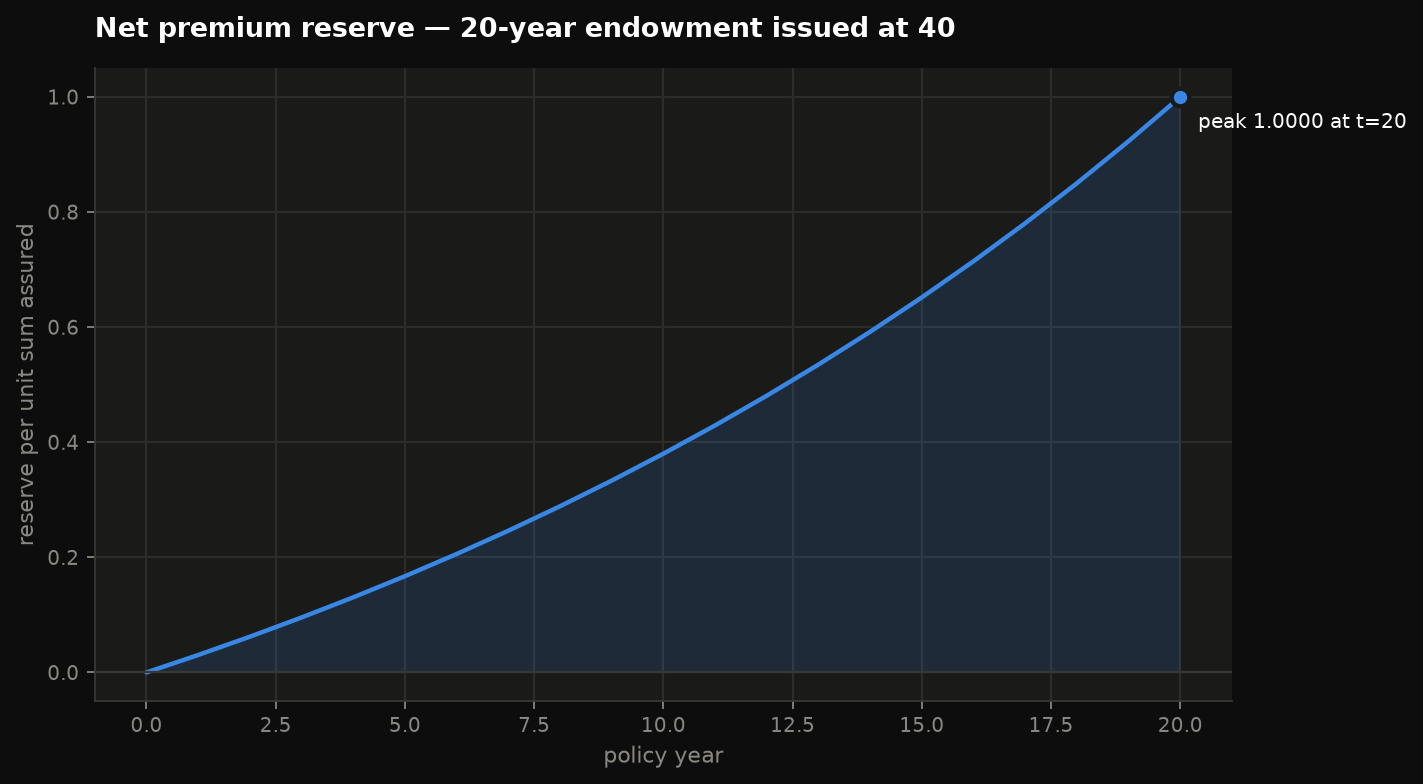
life.net_premium_reserve(sult, 40, t=10, i=0.05, kind="endowment", n=20)   # 0.380073
life.reserve_profile(sult, 40, 0.05, "endowment", n=20)   # [(0, 0.0), (1, …), …, (20, 1.0)]
An endowment's reserve is 0 at issue and exactly 1 at maturity — both ends
are asserted in the tests, as is Fackler's recursion
(ₜV + P)(1 + i) = q_{x+t} + p_{x+t}·ₜ₊₁V at every duration.
What is not here
Select tables (mortality that depends on time since underwriting) and multiple decrement tables are out of scope for this module. Fractional ages are not modelled beyond the UDD and Woolhouse adjustments.
References
- Bowers, Gerber, Hickman, Jones & Nesbitt, Actuarial Mathematics, 2nd ed.
- Dickson, Hardy & Waters, Actuarial Mathematics for Life Contingent Risks, 2nd ed. — the source of the Standard Ultimate Life Table and the printed values the suite reproduces.